 Legion AI
By Casey Morgan Legion AI editorial pen name
How to Follow Up on Unsold Estimates: A Home Services Guide
By the time you send an estimate, you have already paid for the lead and for the visit. If the homeowner goes quiet, a polite, planned follow-up is how you find out whether the job is still alive. This guide sets out why estimates stall, an example sequence across text, call and email, what each message should say, and when to stop.
Why estimates go cold
A silent homeowner has not necessarily said no. Something may have stopped the decision, and each reason calls for a different message:
- They are comparing quotes and want to understand why yours differs.
- The price surprised them and they do not know they can change the scope.
- The work is not urgent, so it slipped behind everything else that week.
- A question went unanswered, about warranty, timing, permits or clean-up.
- Someone else decides: a partner, a landlord or an HOA.
- They lost the estimate in an inbox and feel awkward asking for it again.
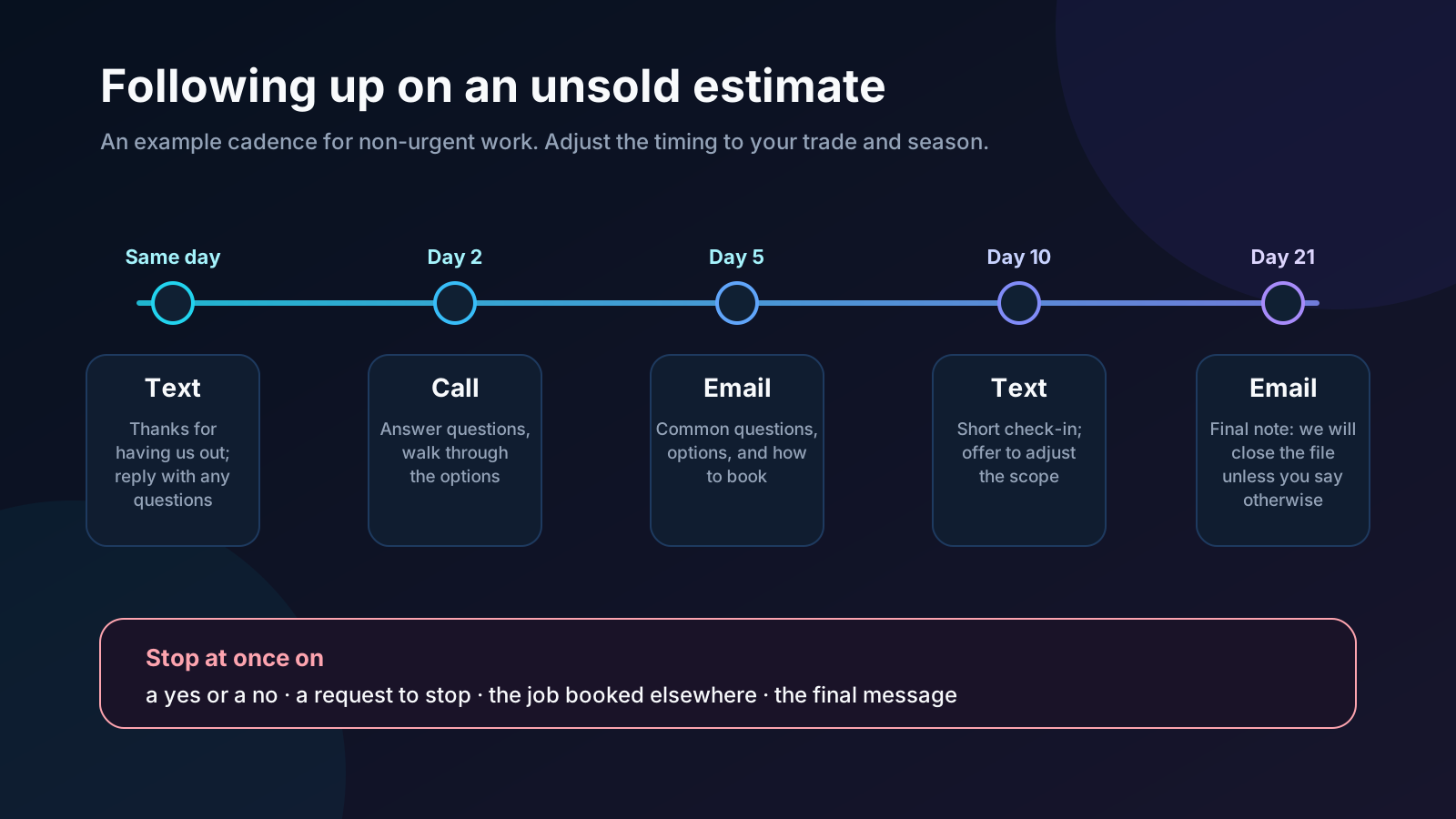
An example follow-up sequence
This example assumes a written estimate for non-urgent work, sent after an in-home visit, to a homeowner who agreed to hear from you by text and email. Adjust the gaps to your trade and season: a furnace replacement in January moves faster than a patio in March.
- Same day, text. “Thanks for having us out today. Your estimate is in your inbox; reply here with any questions.” It confirms the estimate arrived and makes replying easy.
- Day 2, call. Ask whether they have had a chance to look it over and offer to walk through the options. Listen for the reason behind any hesitation; it tells you what to send next.
- Day 5, email. Answer the questions homeowners usually ask about this kind of job, show the options if you offer more than one, and explain how to book. Attach the estimate again.
- Day 10, text. “Still thinking it over? We are happy to adjust the scope or answer anything.” Short, and it opens the door to a smaller job.
- Day 21, email. “We will close your file unless you would like us to keep it open.” A clear last message gives the homeowner an easy way to answer, and it ends the sequence either way.
What each message should do
- One ask per message. A question to answer or a step to take, never both.
- Name the job. “Your water heater estimate” beats “your recent quote”.
- Make replying easy. A text they can answer in a word, a call at a time they chose.
- Skip the pressure. No fake deadlines or “prices go up Friday” unless it is true.
- Sign it as a person. The homeowner met someone at the door; let that person speak.
Consent, opt-outs and quiet hours
Follow-up is only welcome if the homeowner agreed to it. Record how they agreed to hear from you and by which channel, keep texts and calls within reasonable hours, and treat any request to stop as final: end the sequence across every channel, not just the one they replied on. Rules for calls and texts depend on who you contact, how and why; our AI calling and TCPA guide covers the basics. This is general information, not legal advice.
When to stop
Stop when you get a yes or a no, when the homeowner asks you to, when they tell you the job went to someone else, or after the final message. Record the reason: “went with a cheaper quote” and “not this year” are different problems, and the second is worth a note to check back when the season turns.
What to measure
Measure against your own past results, not someone else’s averages. Each month, track estimates sent, how quickly the first follow-up went out, replies, jobs booked from followed-up estimates, and the reasons you were given for a no. If the reasons cluster around price, the fix may be a smaller option rather than more messages; if they cluster around timing, the cadence may simply be too fast.
Where automation fits
The sequence above is easy to plan and hard to keep up when the crew is busy. Speed matters most at the start, as our speed-to-lead guide explains, and consistency matters after that. Legion follows up with new inquiries by AI call, text and email; see how that works in AI lead follow-up, and how it fits home-service businesses on the home services page. Whatever you use, test the sequence and its stop rules on a handful of real estimates before you rely on it.
Continue exploring this topic
7 Lead Nurture Drip Campaign Templates That Actually Convert in 2026
Copy-paste drip sequences for cold leads, no-shows, quote follow-ups, past customers, and more. Built for SMS + email + AI voice.
ReadSpeed to Lead: Why the 5-Minute Rule Still Decides Every Deal
Why the first reply to a new lead matters, how to measure your own response time, and how AI calling helps you answer while the lead is still deciding.
ReadSales Follow-Up Automation: A Practical Multi-Channel Playbook
A complete automated cadence for teams that need consistent follow-up across calls, text, and email.
Read